
A stateless person is “a person who is not considered as a national by any state under the operation of its law”


Ineligible for free education in government schools.

Ineligible for free or subsidised healthcare.

Unable to open a bank account.

Not permitted to obtain a driving licence.

No right to vote in elections.

Restricted freedom of movement, including inability to travel abroad.

Vulnerable to social stigma and discrimination.
Disclaimer: These are only general examples provided for informational purposes. Every case is different — please seek advice from a qualified professional or the relevant authorities for proper guidance.
*If the child has a valid birth certificate with the Malaysian parent’s name(s) stated, they may proceed directly to Step 6.
The timings provided for each step are just for reference; the actual timings will vary on a case-to-case basis.
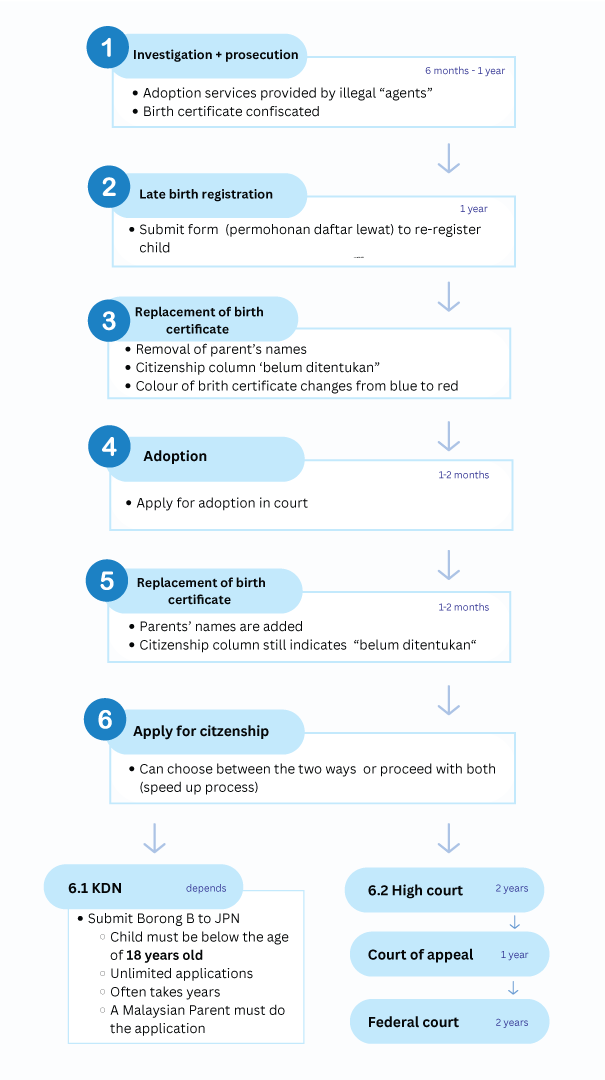
Apply for citizenship before the age of 18
Section 12 of the Births and Deaths Registration Act 1957 requires that every birth in Malaysia be registered within 14 days (and up to 1 year with a late registration fee).
Will I be able to access education as a stateless person?

1. Why is adoption required to apply for citizenship
2. Who can apply for adoption through a lawyer in court?
3. Residence requirement:
4. Special circumstances:
5. Child’s age:
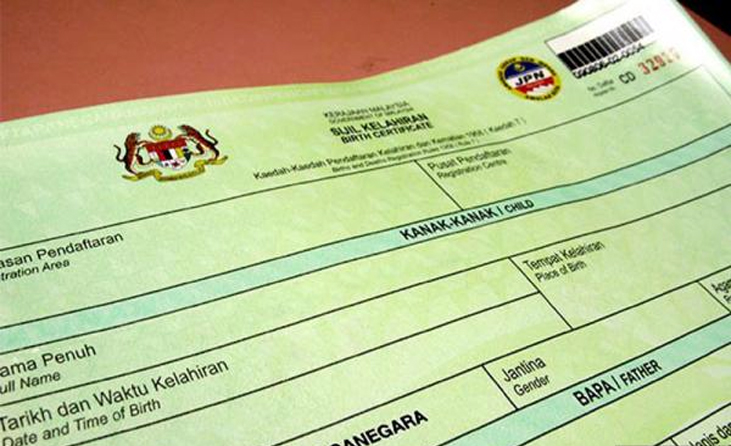
Birth registration is the government’s official record of a child’s birth, giving them legal identity and access to essential rights like healthcare, education, and protection. Without it, children remain invisible in the eyes of the law. Globally, 1 in 4 children under 5 (≈166 million) are unregistered, often due to poverty, remoteness, lack of awareness, or discrimination. UNICEF calls for stronger systems, no fees, better awareness, and integration with health and social services to ensure every child is registered.

Citizenship by operation of law depends on the parents’ marital status
If the mother is a foreign national and the parents are not married at the time of the child’s birth, the child will not be entitled to Malaysian citizenship by operation of law and will instead automatically acquire the mother’s nationality(article 14).

A birth certificate only proves that a birth was registered in Malaysia; it does not prove that the child is a Malaysian citizen.
Children adopted by Malaysian citizens do not automatically become Malaysian
They can legally marry or own property only if they meet documentation rules, but many are excluded because registration requires citizenship or valid ID. Some marriages are valid under religious law but unrecognized civilly.
you can attend public (government or government‐aided) schools if at least one parent is a Malaysian citizen, and if they obtain a letter/certificate confirming that fact from a village chief or equivalent.
where parents are not legally married prior to the child’s birth.
Illgitamate legal documents awareness- very common case
This highlights the importance of ensuring that all adoptions and registrations go through proper legal and official channels.